
Monday, March 11, 2013

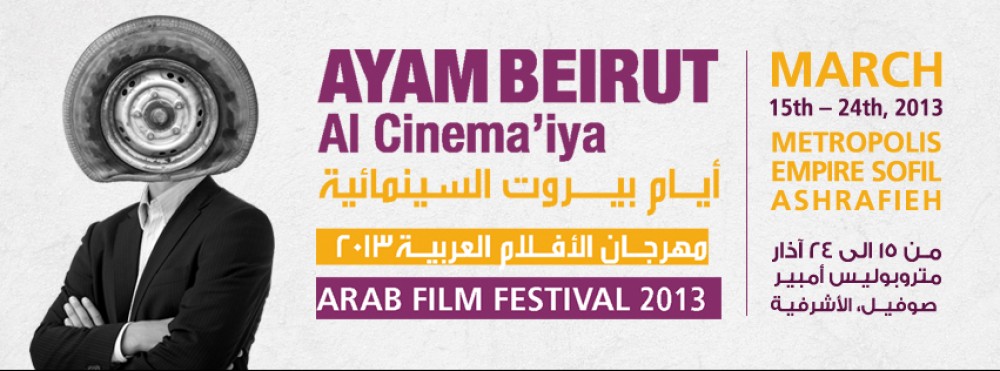
Ayam Beirut Festival - أيّام بيروت السينمائية

https://ayambeirut.files.wordpress.com/2013/02/cropped-blog-header-851-315.jpg

From 15 to 24 March, Ayam Beirut Festival will screen a collection of the newest Lebanese productions. The program is yet to be available, but the list of the participating movies includes some movies which  have mentioned before in this blog (or the associated youtube channel) and has competed in other Film festivals. Lebanese films supporters are encouraged to go as some films will fit their taste.
More updates will be posted.

Update: as noted by Ayam Beirut, the final version of the program is available here.

Update 2: Lebanese Rocket Society has been sold out, I wont be able to watch it to feature it on my blog, even though I was waiting so long for it :( , I should've considered buying the tickets few days ago.

Friday, November 30, 2012

Last Valentine in Beirut - آخر فالنتين في بيروت

Official trailer for Last Valentine in Beirut

This parody movie is the first feature by Salim El-Turk. The director of music-videos "Ajmal Ehsas" and "Enti Mchiti" came up with a movie over-saturated with sarcasm. The feature by El-Turk may be compared roughly to S.L.Film with a difference that it's not backed by a satire T.V. show. The use of stereoscopic filming (marketed as 3D) was somewhat unnecessary as it has steered the director to emphasize on depth effects in scenes even when such effects were of no added value (noted as well in the movie), besides it bloats the ticket price and obliges viewers to leave the theater with a headache after wearing uncomfortable glasses. IMHO, this 19th century "new 3D filming technology" didn't reach the maturity phase yet in order to be embraced by artists. The plot was enjoyable, but the director would've squeeze better performance from its cast including himself. The audience will have fun watching this feature. They will feel the "depth" in the "3D images", but "depth" will be missed in the plot.

Wednesday, September 5, 2012

TIFF 2012

The Attack by Ziad Doueiri

TIFF selection this year will include some very interesting entries from Lebanese and Arab Filmmakers. Among the notable titles, we may mention the third movie by the prominent director Ziad Doueiri (check the trailer above), and the documentary by the couple Jreige and Hadjithomas about the scientific ambitions of Lebanese researchers in pre-war era. Other interesting Arabic films to be screened during the festival are "When I Saw You" the second feature by Anne-Marie Jacir (director of "Salt of this sea") and "Zabana" by Saïd Ould-Khelifa. We hope one of these movies will enjoy the same glory as "Where do we go now?".

The Lebanese Rocket Society by Jreige and HadjiThomas


Update: The distributors decided to take down "the attack" trailer preventing curious viewers to enjoy few scenes from the upcoming movie. The provided rationale is that "[the trailer] says too much about the story and shouldn't be revealed to the public". Instead of suggesting an accompanying 'spoiler alert' tag to the video, thus, they ended up penalizing fans by removing the video.

Saturday, August 18, 2012

Lebanese Film Festival

The Lebanese Film Festival is scheduled between 23-26 August at Metropolis Cinema. The program is rather interesting with some guest entries by Foreign Directors notably by Asghar Farhadi (Whose name was incorrectly misspelled in the programme!). This 10th edition of the festival has gathered a rich collection  of genre from documentaries, music videos, shorts, ...
Unfortunately, even though the only official language in Lebanon is Arabic, the organizers decided to discard the Lebanese official language from the released programme.

Update: The festival was doomed with an unfortunate organization challenged with major technical problems which spoiled some screenings (e.g. The Virgin Butterfly) and few entries were worthy and or politically motivated rather than artistic. The meeting with Nadine Labaki was strangely similar to a press kit of a movie instead of a real interview. We hope that next years bring a better organization and a richer "in competition" selection.

Monday, June 4, 2012

TIFF spotlight on Lebanese Cinema

After the surprise TIFF victory of Where do we go now?, the Lebanese Cinema is grabbing some attention worldwide. The award hosting festival is organizing an event that should interest all International cinema followers, more particularly the middle-east cinema fans. Canada is one main destination of a large Lebanese (and Arab) diaspora, this should give a decent momentum and venue for the proposed program. The selection is rather diverse and should meet all tastes with all participating features are post-civil-war productions. Among the movies on the program: Ok, Enough, GoodBye, Beirut Hotel, Falafel, and many others.
Everyone is encouraged to enjoy the Lebanese flavored cinema which is scheduled starting June 14.

Monday, May 21, 2012

Censorship madness!!

 
Sadly Heels of war is now banned in Lebanon

No one should describe Lebanon as a freedom of speech isle anymore. Once praised as a place of liberty, nowadays, it is becoming more oppressing than any neighboring regime. Today, Heels of war (aka. Tannoura Maxi) got banned in the Lebanese theaters. This sad event follows similar actions which recently prevented Beirut Hotel from being screened, and 33 Days to being rejected on a political background without any sense of reason in any decision (made by theaters owners or the censoring body).
Every Lebanese should voice his refusal against such madness. Everyone should have the right to freedom of expression. All these decisions will contribute to only one thing: shape the Lebanese opinion into becoming more close-minded, therefore, eroding the movie industry that just started to bloom only now. All artists are invited to react sharply against the new oppression rules from gaining more ground and put stop to such insanity.

It is worth-noting that  gulf countries are now more freedom-prone than Lebanon. Films like Beirut Hotel and Heels of war were screened and praised in gulf countries, but rejected in Lebanon.

Update: The movie is now back in theaters, probably after complying to the censorship conditions.

Wednesday, May 16, 2012

Scrapbook

Trailer for Yamo which will be screened starting June 14

For all Lebanese movies fans, Metropolis is dedicating a Month of Lebanese Cinema, the collection varies from documentaries to fictions. All interested people are invited to watch the movies that match their taste.
Among the notable features, Yamo and OK, enough, goodbye whose screening will start on June 14.

Friday, May 4, 2012

Heels of War - تنورة ماكسي

Trailer for "Heels of War"

The long-term project by Joe Bou-Eid finally released into theaters. This movie is full of sensations and temptations. The viewer will enjoy the well tailored romance and the different aspects that helped its creation. Most notably is the charming Joy Karam whose voice was never heard, but her distinguished performance was remarkably attractive to the eye and heart. The plot is  to be a romance story paved with difficulties related to war and religious career, based on the director's parents biography. While the movie is poor on conversations, the Caramelish colored scenes are telling the story smoothly and in an elegant style most of the times accompanied with an amusing western original score. One should note that, if we discard the fact that the title is shown in French and the inconsistently chosen English language for the commentary, the movie lost his Lebanese identity as the supposedly Lebanese village rarely shows Lebanese traditions and most of the time, the customs can be confused with European villages and not from the Levant (e.g. bathtub outside?). Among other annoying details, the lighting is sometimes excessively misused (e.g. inside the room, light is spotted on the face of the retarded sister makes it completely fake and unnecessary). Despite these few issues (reminder: first feature by Joe), all are encouraged to degust this sensual piece of art.

Update: The movie was withdrawn from Lebanese theaters due to church intervention.

Saturday, April 28, 2012

Young Talent - revisited

Demo Reel 2011 by Nareg Kalenderian

We featured Nareg back in 2009. Few years later, Nareg is proving his talent once more with his new short animation. Nareg is an artist who taught himself the different techniques in 3D animations (textures, materials, lighting, modeling, rigging, animating, rendering, ...). Even though self-taught, his art is, without any doubt, of great quality. He managed to improve his techniques thoroughly by working in local and international film industry (which includes Pixar). He worked on some animations in local and regional ads and effects in some foreign movies. But his skills surpasses these of an effects artist, and deliver some great costumes, makeup, sets design, cinematograpy all gathered with an outstanding art direction. Simply he showed himself talented in every film crew job, and more importantly he proved himself as an authentic director who takes care excessively of all details in a scene. Unfortunately, the infrastructure in Lebanon is holding him back, in more than one instance, he mentioned that the rendering of the reel took around 6 months with no possibility to run the bake 24/7 because of the regular power cut-off, which delayed significantly his result and reduced his productivity (note that the reel is done in his spare time!). We hope that his talent would get regional investors' attention to produce soon a first long animated feature from our region, with an attractive style and mood similar than those found in his reels.

Nareg in a picture taken by DFI

Sunday, April 22, 2012

33 days (Drama) - ٣٣ يوم


Trailer for the drama 33 days

Not to be confused with the documentary, 33 days is a historical drama that attempts to build a feature during the start of the Israeli war against Lebanon in 2006. It depicts the first few days at Ayta el Chaab during the 33 days of the war where Israel mercilessly shelled and bombed indiscriminately Lebanon, especially the southern villages. The armed resistance and the population manages to fight back. As advertised, the joint Iranian-Lebanese production resulted in a big budget movie bloated with high comparse number and special effects such as explosions and computer-generated imagery (CGI). The integration of the effects enjoyed an elegant level of realism. The cast members included some acclaimed actors and some young ones. Carmen Lebboss acting dwarfs all the other performances, this huge gap is somewhat annoying to the viewer. Darine Hamze is proving her talent as an actor by selecting a role that differs radically from her previous ones each time. She manages to deliver some acceptable performance despite the use of the Hebrew which she learned to play the associated role. Unlike the cast and the special effects, the script lacks polishing and reviews. This experience should help the movie makers in the future to learn from current mistakes to produce better films. While this movie may entertain the viewers, personally, I find the same titled documentary a more educating and mind catching reel. Note that while the documentary focuses on the war away from the front line from refugees and civilians perspective for the whole 33 days, this current drama point the camera almost exclusively on the fought battles in the southern villages for the first few days only not 33 days as the title misleads. Another note, the finishing credits doesn't use Arabic at all in the role description of the crew.

Update: Some theaters in Lebanon canceled or postponed the screening of the movie. This is sad news, it can be only considered as a form of censorship, not a government censorship, but rather politically motivated one.

Thursday, March 29, 2012

a Man of Honor - إنسان شريف

  Trailer of a Man of Honor

The second feature by Jean-Claude Codsi which was screened during Doha Tribeca Film Festival has gained finally some narrow theater screenings in Lebanon (only 2 currently). Even though most cast and artists are Lebanese, the story, who excogitates the honor killing practice, takes place in Jordan where this practice is relatively vivid. This feature might bring some notable similarities with a Lost Man who takes part in Jordan as well, but with a somewhat reverse circumstances, in Codsi's movie, the Jordanian man flees to Lebanon, while in Arbid's one, the Lebanese man flees to Jordan. Bernadette Hodeib participation is of no doubt distinguished regardless of its duration. Note that the Lebanese actors manages to (effortfully?) speaking the Jordanian dialect, this didn't had much influence on the narrative and the mostly refined built plot. Personally, I found one particular scene incorporating some unnecessary exaggeration; the director purposely mutates traditional practices into some primitive foreign ritual that mimic those of isolated tribes (in Amazon or maybe tribal Africa?). This might be a bottleneck for the storytelling to assert the fustiness of such crimes, but of course exaggerated to amplify the effect. The spotlight covered in this film is an interesting perspective, worth seeing and will be much appreciated by the viewer, along with the pleasant music of Toufic Farroukh.

Edit: It should be noted, that this movie, like other recent Lebanese releases is including French and English subtitles. This increasing trend is getting ridiculous. Should Lebanese be bound by subtitles on all movies, even those narrated in their own Language?

Friday, March 9, 2012

Taxi Ballad - تاكسي البلد

Trailer for Taxi Ballad

Recently released widely in Lebanese Theaters, Taxi Ballad is a first attempt for Daniel Joseph to direct feature films. The movie is about an "underachieving" Lebanese Taxi driver's ambitions with a remarkably good level in English(?). The debut of the movie is little disappointing with a curious decision to reveal the movie title solely in Latin script, while completely discarding Arabic. The same remark holds for the credits in the end. Another disappointing decision is to screen the movie with French subtitles. Such absurd decision can be only seen as if the distributors think that the Lebanese language cannot be understood by Lebanese audience! (see also Where do we go now? who managed to rectify later this problem is some theaters)
The film is overly nice keeping in mind that this is first long feature for the director, with hope that he will learn from this experience to give us in the future even better movies. Most nature scenes are beautifully colored, but some elements are felt missing every time, making it little credible in faithfully presenting the Lebanese life. The storyline can be enjoyable, but its structure could've been better built. We should note that most actors played their role naturally, most notably the honorable presence of Mahmoud Mabsout (Fahman) who died recently and whose role was inspired from a previous character in Beirut After Shave.
Most audience would enjoy the movie, and are encouraged to watch it in order to support the Lebanese movie productions in the future.

Parenthesis: I couldn't help noticing this currently growing trend where foreign actors costarring the Lebanese movie. I suspect that the reason might be the foreign funding, but this could not be the only one. (e.g. Beirut Hotel, Where do we go now?Taxi Ballad, Une Chanson dans la tête﴿

Thursday, February 9, 2012

1958 - ١٩٥٨

Trailer for "1958"

While waiting for the screening of the movie, people were wondering among different materials in the exhibition named "Revolution vs. Revolution" at the Beirut art center. When the screening starts, one can deduce why the movie blends naturally in the theme of the ongoing exhibition. As the name suggests, the "essay" movie (as described by the director), the movie revolve around the year of the birth of Salhab and the different events that stormed his home country during that time. Based on the testimony of his mother (the pillar of the movie as called by the director), the story of the internal violent conflicts were told in parallel, while the testimony focuses more on the mother's feelings when going to Dakar and having her first child. The father testimony was absent, while other testimonies were added to give some equilibrium (was it needed?) to the story. Mixed with few French poems written by the director, some archive footage, and dramatized scenes, the movie offered the audience a retrospective on an integral part of the Lebanese History that was chosen to be forgotten.

Wednesday, February 1, 2012

Beirut Hotel (review) - بيروت بالليل

Trailer for "Beirut Hotel"

Lebanese audience watched this feature in defiance to the infamous ban that is imposed, and proved that such censorship is rather meaningless in a connected world. Arte channel, a main contributor to the movie, screened Beirut Hotel earlier in January. The movie was scheduled to be released in Lebanese theaters prior to the TV release, but the ban prevented this from happening. The movie is carefully made, and it was selected for many festivals, there is no clear reason why it wasn't selected for Cannes this year although it was supported by "The Atelier". The actress Hamze was playing one of her best roles in her career, thanks to Arbid's direction. Nevertheless, few problems arose related to the erotic scenes in the original trailer. Overall, Arbid is proving once more her great talent by a successful third movie attracting audience (Western and Arabs). The plot revolves around a love affair intersecting with a spy story. As in her previous movie, the main cast is divided between a French actor, and an Arab one. They met by chance, and the French begin stalking the Arab until they bond together. The cinematography is rather eye-candy, revealing an appealing Beirut in a colorful picture. The unfortunate ban have contributed to raising awareness among the population and promoting the movie (approximately 1.5 million watched the TV release including 700,000 in France alone + 34,000 on the web). The last chance to watch Beirut Hotel on arte is scheduled on February 4th 01:40 GMT+1.

Monday, January 30, 2012

Territory of Rose - خلة وردة

Trailer for Territor of Rose

After directing many music videos and advertisement, Adel Serhan had a first experience in feature movie Territory of Rose. The movie tells a story of a village during the occupation of South Lebanon and the atrocities committed by Lahd conspirators army. Despite the harsh reality, the film managed to gather a light touch of humor and a challenging entertaining plot. Nevertheless, the low production budget imposed itself by a humble quality of many technical aspects (photography, makeup, etc). For some reason, the projection in theaters had a DVD resolution, which devalues the picture quality enormously. Nevertheless, it's an entertaining movie, and will satisfy a big share of the audience expectations.

Saturday, December 10, 2011

Censorship craze

Artistic creations in Lebanon is facing a new challenge with the recent announcement about canceling the long-awaited screening of Beirut Hotel in Lebanon theaters by the censorship committee. As suggested, the film was banned due to political reason, not for the intimate scenes inside, it was considered as it would "endanger Lebanon's security"! We hope that this decision will be reverted quickly and witness the release of the film soon in Lebanon.

We take this occasion to hope best luck for the director Danielle Arbid during the screening of this movie in Dubai during the DIFF. Apparently the margin of freedom is getting wider in Dubai, in contrast to Beirut.

Note: Thanks for the Independist for pointing out to this sad story.

Monday, December 5, 2011

Ok, Enough, Goodbye - طيّب، خلص، يلّا

Scenes from "Ok, Enough, Goodbye"

The main theme of this movie is the city of Tripoli. Painted in beautiful colors and the enjoyable dialect of the second Lebanese city, this feature manages to attract the audiences by a light comedy, yet charged with analysis of the society in the general Lebanese life.  Among the thoughts that emerge upon watching it is the reliance of the Lebanese male on women. When the mother of the main character leaves home (for a reason that would've been better accepted if explained more in the script), he exhaust every available means to compensate her absence. I will avoid any spoilers, it's an amusing first film made by young directors a Lebanese Tripolitan Rania Attieh and Daniel Garcia, a foreigner. As described by the film makers, the production was mainly a "two person" work, with most cast selected among Rania's own family, reducing the budget to a micro one. Nevertheless, the movie is fun and highly recommended... Hoping to be screened in Tripoli soon!

One of the used posters

Monday, November 7, 2011

The Mountain - الجبل

Trailer of "The Mountain"

The latest movie by Ghassan Salhab, The Mountain, follows the style of The Last Man with the minimum use of conversations and reduce the cast to almost one actor with all the difficulties that ensue when producing under such decision. The movie tells the story of a man who decides to isolate himself to concentrate on wirting in some hotel room in a remote mountain region. The isolation is nearly complete with TV, phones and other means of communication cut-off, but also the window closed down, hence loosing the sense of day and night. Fadi Abi Samra who plays the leading role impersonates the isolated man situation in a very convincing way. Ghassan Salhab manages another time to escape from the cliché themes originating from movies in our region to draw fictional scenes that can be set anywhere (despite some elements that would relate to Lebanon such as radio news stories). Some ideas in the movie can be seen echoed in other features like A Lost Man which tells the story of a man who decided to run away from his country, or The One Man Village a documentary where a single man lives alone isolated  in a far away village. Salhab was able to shed the light on this issue in a new angle, tickling the memory of the viewer of similar moments of loneliness, and the corresponding audio and visual sensations that follows. This film is not a general public movie, nonetheless, it will provide a new interesting experience to the viewer.

Sunday, September 25, 2011

Where do we go now? (review) - وهلّأ لوين؟

HD trailer of Where do we go now?

After long wait, Labaki's second feature is released in Lebanese theaters. Unfortunately, this time Lebanon was not a priority on the release schedule, France beat us to be the first to release the movie to the public :-(.
To describe the movie simply, it's a must-see exquisite tale full of emotions, inspirations and motivations. Anyone should enjoy it. It's a movie about peace, not war. Unlike what some myopic Western critics say that it's a movie about a war between Christians and Muslims, it is wiser to see it as a universal movie to eliminate division, to reduce discrimination of all forms (not only religious), and avoid wars. In contrast to In the Battlefields, it should be noted that Where do we go now? throws the division problems to outsider agents, and avoid tackling the hatred that is originating from within. Nevertheless, It merits all the awards that it's currently gathering. The music, along with the intelligent lyrics by Tania Saleh, makes an integral part of the story and cannot be separated. You can enjoy the complete original score at Mouzanar's myspace. Although it may reveal some of the plot, even if listened apart.
The actors are very natural, most noticeably talented is clearly Claude Baz playing as Takla. The microcosm goal of Labaki was reached successfully. Nadine's directing talent becomes very clear by her manipulation of the emotion with such an ease: flipping the audience from laughter to tears in seconds. As in Caramel, the messages are passed smoothly to the viewer. Nadine is very talented in knowing how to attract the viewers, and she continues to confirm this assertion with each new work. This debuted long ago when she started her career, but it's getting more obvious with the collection of audience prizes almost everywhere: Tornoto Festival, and the San Sebastián Festival (for her second feature, she lost to second place by a thin margin of a mere 32 votes out of 9,046).
Even though it might be considered as Nadine's signature, some transitions might be felt interrupted, but at no time, it may disturb.
My single complaint is that, for some reason, the Lebanese theaters decided to include subtitles for Lebanese audience! Why would anyone think that the Lebanese people need English subtitles to understand Arabic in Lebanese dialect?!! Whose decision is it anyway? Unfortunately, aside distracting the viewer from the beautifully set scenes, the subtitles even spoiled and overrode  the nicely designed movie Arabic title at the beginning :-(. One might think that subtitles are added for foreigners, but it becomes even more disturbing when you witness English passage went untranslated to Arabic. Usually, one or two theaters may include subtitles, but to implement this decision nation-wide might be considered somewhat offending! Note that, when Caramel was released, the release date in Lebanon preceded that of France, and the film was released without any subtitles in the theaters.
Among minor "glitches" (or minor directing mistakes), I couldn't help noticing that the only victim received a bullet in a place that should be normally protected with the worn helmet, yet the helmet remains intact. Another glitch, the cross got broken in a visibly artificial way, leaving behind 2 bars with the sawed regular (rectilinear) sections clearly apparent.

Sunday, September 18, 2011

TIFF Victory!

"Where do we go now?" won the prestigious People's Choice Award at Toronto Film Festival. Unfortunately, Labaki was not present there to deliver a speech.
We would like to congratulate Labaki and her team for their success in making such a good movie. The movie is already enjoying a popular success among French film viewers since its public release few days ago.
A reminder that in the recent years, previous winners at TIFF won the Best Picture Oscars at the Academy Awards.